



Our selves
 James Cathcart
 October 28, 2026


 Add to Favourites


Listen to this daily worship
Micah 7: 18–20 (NIV-UK)
18
Who is a God like you,
who pardons sin and forgives the transgression
of the remnant of his inheritance?
You do not stay angry for ever
but delight to show mercy.19
You will again have compassion on us;
you will tread our sins underfoot
and hurl all our iniquities into the depths of the sea.20
You will be faithful to Jacob,
and show love to Abraham,
as you pledged on oath to our ancestors
in days long ago.
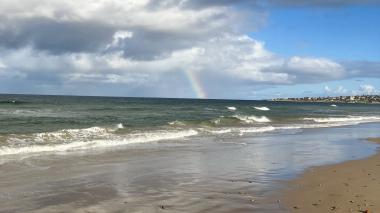
The Bible is not a book we read. It’s a place we go. Picture a beach at the ocean of time. It is made of countless fragments and layers, a cohesive whole made from a mosaic of salt and sand, time and water, sky and rock.
A beach combined is a place of incredible beauty but not everything we find here is beautiful. There’s litter and destruction, death and decay, the scars of erosion and storm and disaster. But too there are intricate shells, crooked driftwood, sparkling rock pools, skies that must be painted, the music of gentle waves, and stretches of glorious sand — made new every few hours — that invite us deeper into this present moment.
A beach is a place equally shaped by deep time and daily rhythms. Where microplastics from today intermingle with shards of pottery from centuries ago and fossils from millennia ago. Indeed, the artistry of a beach is expressed in the medium of time.
Time that has created soft sand from unyielding rock, time that scuds the clouds across the sky, time that takes away and yet also returns bringing treasures to the shore.
Despite all the postcards, a beach cannot be truly captured in a still image. A beach is something that only makes sense caught in movement. When ordinary sand, rock, salt, water and air come together in a unique animation, a reaction of place and weather and time. It is only truly itself in the given moment it is. You have to be there.
It’s the same with the Bible.
The prophet Micah stands at the shore amazed that God takes all our historic failures, all the shame and best intentions, lapses and aberrations, the good money that’s been thrown after bad, and hurls them into the depths of the sea. How does the finality of such forgiveness change us?
Prayer:
Standing at the shore,
We bring our world
to your Bible,
to the deep time of the universe,
to the stories and lives centuries apart from us,
to the place outside of time where you love us.
Thank you for taking all the regrets that weigh us down
and hurling them into the sea
where they can sink without trace.
Amen.
Connect Bible Study
Read the Connect Bible Study that goes along with this week of Daily Worship.






Login to comment.